East Village Mennonite opposition to women’s university education
All My Puny SorrowsEast Village Mennonite opposition to women’s university education was a gendered form of communal control, enforced through the authority of church elders and suspicion of the ideas that education might bring. Its conflict with Elfrieda Von Riesen’s musical ambitions makes the rule concrete: when she was fifteen, her plans for university study prompted an intimidating visit to her family home; by seventeen, she had earned scholarships and was leaving for Norway to pursue music.
Enforcement and Gendered Suspicion
The opposition became visible when the bishop and a group of elders arrived at the Von Riesen home after hearing that Elfrieda intended to study music at university. She was only fifteen, but a local informant had reported her wish to leave the community. The elders’ concern focused especially on higher learning for girls, which they associated with young women acquiring ideas and distancing themselves from East Village. Their response treated an educational plan not as a private family decision but as a challenge to communal authority.
The visit was staged to exert pressure. The bishop arrived on a Saturday with thirteen or fourteen elders in separate black cars, and the men gathered in the living room while Elfrieda’s father remained with them. Her mother stayed in the kitchen rather than serving refreshments or lending the gathering the customary appearance of hospitality. Her refusal to participate marked a quiet resistance, even as her husband struggled to oppose the visitors directly. The episode shows how the rule could be enforced without a formal hearing: collective presence and the family’s awareness of the elders’ power made the visit itself a warning.
Musical Education as Resistance
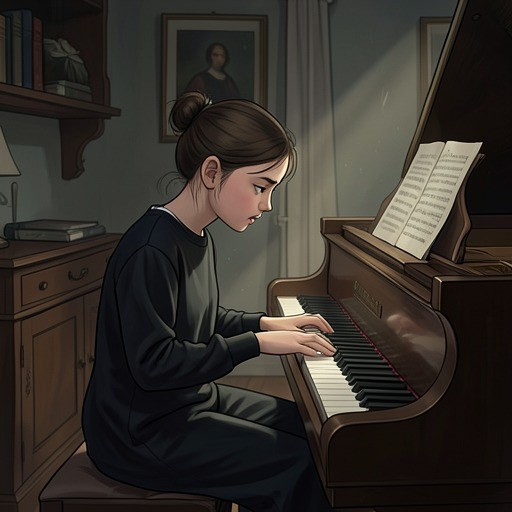
The elders’ challenge took place beside a piano that was itself forbidden in East Village. Elfrieda’s parents had secretly brought it into their home after a doctor recommended a creative outlet for her. For years they covered it with sheets and gunny sacks when elders visited. Elfrieda studied with a Winnipeg conservatory teacher who drove to the house twice a week, and she worked for two years on Rachmaninoff’s Prelude in G Minor, Op. 23. Her musical training therefore depended on a fragile accommodation: lessons took place at home, behind a practice of concealment, while the community’s restrictions remained in force.
During the elders’ visit, Elfrieda played the prelude from the spare bedroom. The men fell silent. Her performance turned music into a response to the pressure directed at her education: rather than argue her case in the living room, she made her seriousness and ability audible. The family had come to value her playing and had sometimes asked her to perform familiar songs, but the elders ultimately allowed the piano only on the condition that her parents ensure she used it as an instrument for the Lord. That compromise did not remove the restriction; it placed her art under religious supervision.
Departure and the Rule’s Limits
The elders’ resistance did not prevent Elfrieda from pursuing musical study. She completed high school early, at Christmas, earned honours in every subject, received six piano-study scholarships, and won a Governor General of Canada prize for the highest marks. These achievements intensified the elders’ anger and fear, showing how academic distinction could become another source of communal conflict rather than a reason to celebrate her prospects.
At seventeen, Elfrieda left for Norway for a recital and to study with an older teacher she called the Wizard of Oslo. Her departure followed years of musical work and the earlier confrontation over university. The evidence establishes her study in Norway, not that she attended university there; what it does show is that opposition to women’s higher education could not keep her ambitions within the boundaries set by East Village.
Narrative Significance
The account presents the restriction through a particular family conflict rather than as a rulebook. Its force lies in the way church authority enters the home, questions a teenage girl’s plans, and expects her father to submit. The family’s concealed piano and the elders’ conditional permission reveal the narrow space allowed for female talent: music could be tolerated when supervised and religiously framed, but education that might enable a girl to leave remained suspect.
Elfrieda’s later departure makes the confrontation an early measure of the distance between her ambitions and the community’s expectations. Her musical success does not erase the pressure she faced; it demonstrates that the pressure failed to contain her. In the novel, the opposition to women’s education is thus part of a larger struggle over who may shape a young woman’s future and whether her gifts belong to her or to the community that seeks to govern them.